
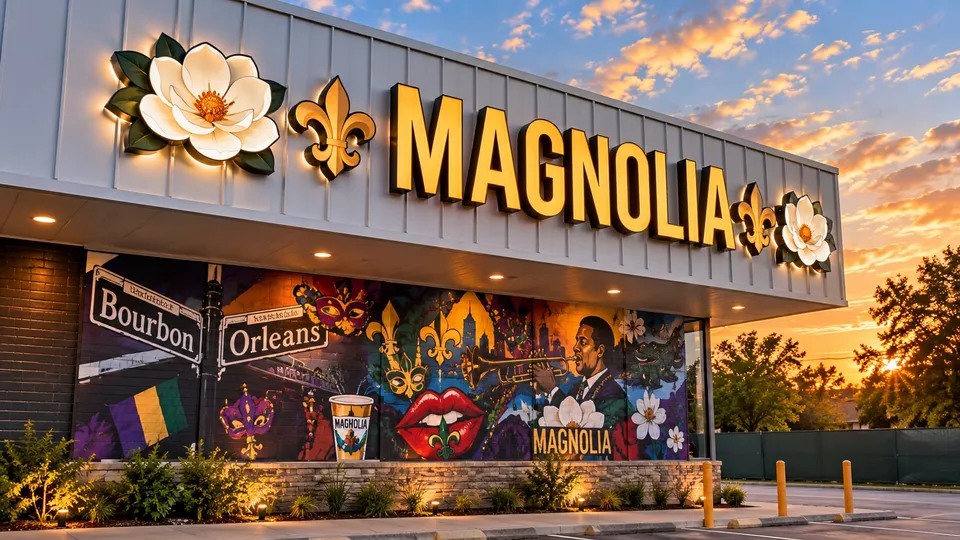
What a channel letter sign actually is
Channel letters are individual, three-dimensional letters and logo shapes, each one a shallow metal “channel” with its own light source inside. They are the standard for retail storefronts, restaurants, medical offices and multi-tenant centers across Houston because they read clearly day and night and because most landlord sign criteria require them.
Each letter is built from an aluminum return (the side wall, usually 3 to 5 inches deep), an aluminum back, and either an acrylic face or a metal face depending on how it is lit. LED modules are mounted inside, wired to low-voltage power supplies that live either in a raceway behind the letters or inside the building.
Front-lit, reverse, and combination letters
Front-lit letters have translucent acrylic faces, usually 3/16-inch thick, held in a trim cap. Light passes through the face, so the letter itself glows. Faces can be white, colored acrylic, or white acrylic with translucent vinyl to match a brand color. This is what most people picture when they think of a lit sign, and it is the most visible option from a distance.
Reverse or halo-lit letters have opaque metal faces and clear polycarbonate backs. The LEDs face the wall, so light spills out around each letter and creates a halo. They are mounted on stand-offs an inch or two off the wall to give the light room. Halo letters look refined and are popular for professional buildings, hotels and medical practices. They do depend on the wall behind them: a light, flat wall gives a crisp halo, a dark or heavily textured wall absorbs it.
Combination letters light both the face and the halo, often in two colors. They cost more but give the strongest presence.
Materials and components we use
- Returns and backs: aluminum, typically .040-inch returns with a .063-inch back, pre-coated or painted. Aluminum does not rust in Houston humidity.
- Faces: 3/16-inch acrylic for front-lit letters; aluminum for reverse letters.
- Trim cap: the colored plastic edge that holds the face. Standard colors are stocked; custom colors are painted.
- Illumination: LED modules sized to the letter depth and stroke width, with UL-listed power supplies. We do not install neon in new letters; LEDs run cooler, draw a fraction of the power and are far easier to service.
- Mounting: either a raceway (an aluminum box that carries the letters and holds the electrical) or flush mount with the letters fastened directly to the wall and wiring fed through.
Every set is assembled and lit in our shop on Harwin Drive before it ships, so what goes on your wall has already been tested.
Sizing letters for your building
Letter height is driven by three things: how far away people read the sign, how tall your sign band is, and what the landlord criteria allow. As a starting point, one inch of capital letter height per ten feet of viewing distance gives comfortable legibility. A pad site near the road might work with 18-inch letters; an anchor tenant set back across a parking field usually needs 30 inches or more.
Stroke width matters too. Very thin script fonts do not leave room for LED modules and can look weak at night, so we sometimes recommend a slightly bolder weight or a backer panel to carry a thin logo.
Raceway versus flush mount
A raceway is a rectangular aluminum housing, painted to match the wall, that the letters mount to. The power supplies and wiring sit inside it, so the building only needs a single electrical penetration. Landlords of multi-tenant centers usually require raceways because when a tenant leaves, the sign comes off in one piece and leaves one patch instead of dozens of holes.
Flush mount letters attach directly to the fascia, and each letter’s wiring passes through the wall to power supplies mounted behind it. It looks cleaner, particularly for halo-lit letters, but it needs access behind the wall and it leaves more penetrations. Freestanding buildings, owner-occupied offices and medical practices often go this route.
What affects the cost
Installed channel letter sets in the Houston area typically fall in the ranges shown below. The main cost drivers are:
- Letter height and total length. Bigger letters mean more aluminum, more acrylic and more LEDs, and the set may cross a permit threshold that adds engineering.
- Illumination type. Reverse and combination letters take more labor per letter than front-lit.
- Mounting. Raceway sets install faster; flush mounts take more time on the wall.
- Wall type and height. Second-story installs or tilt-wall concrete take more equipment and time than a single-story EIFS fascia.
- Permitting. A City of Houston application with an electrical permit and a sealed attachment calculation costs more than an unincorporated Harris County job.
Timelines
Once artwork and the landlord’s approval are in hand, we start the permit and fabrication in parallel. The City of Houston typically returns a sign and electrical permit in about two to three weeks; fabrication runs a similar window. Most sets are on the wall within four to six weeks of a signed proposal, with a one-day installation. Custom-painted colors, faces with printed graphics, and permit comments are the usual reasons a job runs longer, and we tell you up front when we see one coming.
Common Houston situations we handle
- New tenant in a retail center. We read the landlord’s sign criteria, build to it, and get the landlord sign-off before we submit the permit.
- Rebrand. New letters on an existing raceway or pattern, with the old set removed and the wall patched the same day.
- Dark letters. If your existing letters have failing LEDs or a dead power supply, our sign repair and LED retrofit crew can often bring them back for far less than a new set.
- Multiple locations. Dental groups, restaurant franchises and auto service chains get one set of drawings that we adapt per site, which keeps permits moving and pricing consistent.
If you are comparing quotes, ask each company three questions: who pulls the permit, who does the electrical hookup, and whether the price includes the crane or lift. Ours includes all three.