
MorSigns

gas station signage Houston

Petroleum and C-Store Signage in Houston: Canopies, Pylons, Price Signs and Rebrands

The forecourt is where a fuel brand is judged. We handle the canopy, the dispensers, the price pylon and the store sign as one permitted, installed package, and we do it while you keep pumping.

  • Canopy, dispenser and lane signage
  • Daktronics certified: sales, install and service
  • Brand conversions phased around operations
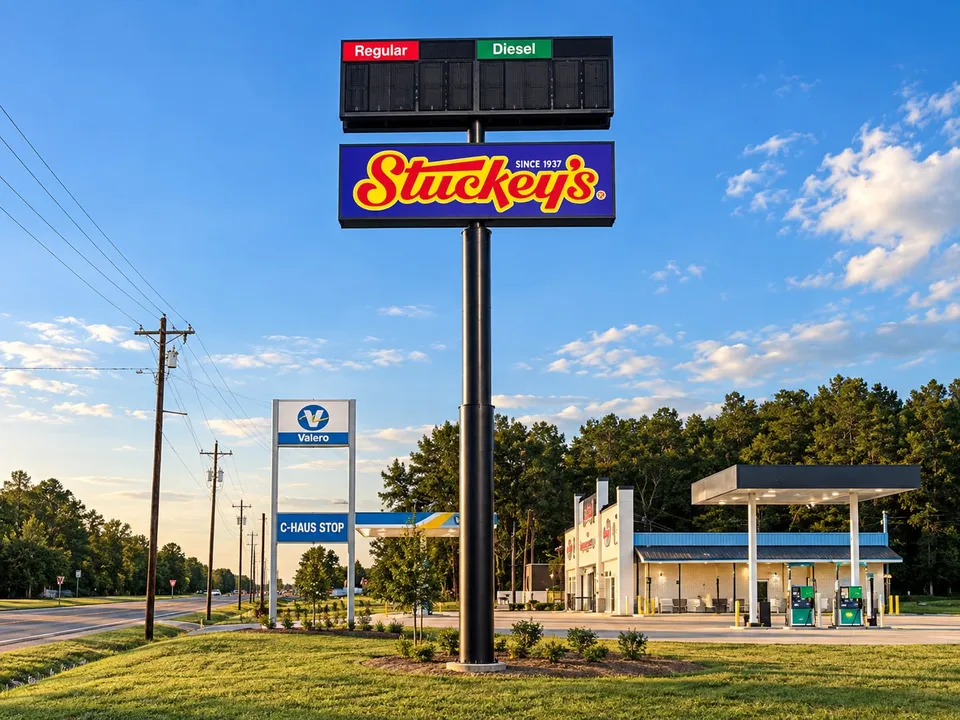
Ninety-foot single-pole high-rise pylon at a travel stop with a Stuckey's cabinet and a regular and diesel LED price sign on top, a shorter Valero mid-rise sign beside it, and the fuel canopy and store behind
Stuckey's, 90-foot high-rise pylon with LED price sign · Houston, TX

Why forecourt signage is its own trade

A fuel site is the most sign-dense property most people ever drive onto. The canopy carries the brand at highway scale, the pylon carries the price, the dispensers carry the brand a second time at arm’s length, and the store, the car wash and the food counter each carry their own identity. All of it runs 24 hours a day, all of it has to match a brand manual, and all of it has to be replaced or repaired without shutting down the pumps.

MorSigns handles that whole package for Houston-area operators: the canopy, the dispensers and lanes, the pylon and price sign, and the building signs, permitted and installed by one crew that schedules around fuel operations rather than in spite of them.

Canopy, dispenser and lane signage

The canopy is the biggest sign on the site and the first thing a driver reads from the road. We fabricate and install:

  • Canopy fascia and cladding: aluminum composite (ACM) fascia panels and cladding in the brand’s colors and profile, replacing faded or dented fascia or re-skinning an existing canopy for a new brand.
  • Illuminated canopy signs: the brand logo and name on each fascia side, LED-lit, sized and placed to the image manual and to what the local code allows.
  • Valance graphics and color bands: the printed or painted bands that carry the brand’s color scheme around the canopy.
  • Dispenser graphics and pump toppers: brand skins on the dispenser housings, pump-number and lane-ID signs, and toppers for promotions or loyalty programs.
  • Lane markers and directional signs: enter and exit signs, diesel and DEF lane markers, clearance bars, and the low-profile signs that keep traffic moving through the islands.

Because a canopy is a structure in its own right, illuminated canopy signs need sealed attachment calculations, and in the City of Houston they need sign and electrical permits like any other illuminated sign.

Pylons, building signs and LED price changers

The price pylon does two jobs: it identifies the brand from the road, and it changes the price several times a week. We build new pylon signs with integrated LED price changers, and we retrofit price units onto existing pylons when the structure is sound.

LED price signs from Daktronics, which we are certified to sell, install and service, are specified by the number of products, digit height (which sets how far away the price reads) and whether the sign is single- or double-faced. The controller sits inside the store and connects by cable or wireless link; we run the wiring, mount the units and commission them with the controller. Because a pylon sits on Houston clay and faces Gulf Coast wind, adding a price sign to an old pylon sometimes means the engineer wants to see the base plate and foundation first.

Building signs for the store are the same channel letters and cabinets we build for any retail tenant, with one difference: the store brand and the fuel brand often belong to different companies with different manuals, and the code counts every sign on the site against the property’s allowance. We draw the whole site together so nothing gets permitted twice or refused once.

Car wash and food-service signs, menu boards and drive-through signage go on the same drawing set when the site has them.

Rebrands, re-images and conversions

A brand conversion touches every sign on the property at once, usually on a deadline set by the new brand and a removal requirement set by the old one. Re-image programs are lighter: the brand stays but the look changes, and the work has to match the manual’s new version exactly.

Our approach for both:

  1. Survey and inventory of every sign, fascia side, dispenser and price unit, with photos and measurements, so the drawings and the permit application are complete the first time.
  2. One drawing set for the whole site, submitted to the brand for approval and to the city for permits, including the engineering for the canopy signs and the pylon.
  3. Phased installation that keeps the store open and most lanes pumping: fascia sides one at a time, islands one at a time, the pylon and price sign at night.
  4. Removal of the outgoing brand to its requirements, with the old elements documented and disposed of.
  5. Completion photos for the brand’s compliance file and yours.

A conversion is also the right moment to fix the things that were never going to be fixed otherwise: dark canopy signs, a leaning pylon, dispensers with three generations of decals. We flag them at the survey and price them as options.

Who we work with

Independent operators with one or several sites, jobbers and fuel distributors managing a dealer network in the Houston area, and general contractors building new stations who need the sign package permitted alongside the building. If you are a dealer whose brand is sending you a re-image deadline, send us the brand’s package and the site address and we will tell you what the permit side looks like before you commit.

What affects the cost

The two ranges below cover the most common requests: re-imaging one canopy, and adding an LED price sign to an existing pylon. Full conversions and new pylons are quoted from the site survey because the sign count and the structural work vary so much from one station to the next. The drivers are the number of canopy sides and signs, whether the price sign is new or retrofitted, how much of the work has to happen at night, and the permit and engineering load, which is heavier for a fuel site than for almost any other property.

Timelines

Brand approval and permits are the long pole, typically several weeks, and fascia panels and LED price units have manufacturer lead times on top of that. Once materials are on hand, a single-canopy re-image is a matter of days, and a price-sign retrofit is usually one night. Full conversions run in phases over one to three weeks on site depending on the sign count. We build the schedule backward from the brand’s deadline and tell you early if the permit timing puts it at risk.

Pricing

What it typically costs, installed

Real installed totals for the Houston area, not a rate card. Every number below includes fabrication, permit drawings and installation unless noted.

Canopy fascia re-image (one canopy)

$6,000$35,000

Installed. New fascia panels or cladding, illuminated canopy signs, valance graphics, removal of the old brand elements, permit and installation.

What moves the number

  • Canopy size and number of fascia sides
  • Lit canopy signs vs. graphics only
  • ACM cladding vs. printed panels
  • Working around fuel operations and hours
  • Permit requirements for illuminated signs

LED price sign added to an existing pylon

$6,000$30,000

Installed. LED price changer units, cabinet modification or new cabinet, wiring to the controller, permit and installation.

What moves the number

  • Number of products and digit height
  • Single- vs. double-face
  • Structural work needed on the existing pylon
  • Electrical run and controller location

A new pylon with an integrated price sign is quoted under pylon signs.

Ranges are typical installed totals for the Houston area and are not a quote. Your price depends on the drivers listed; we confirm it after a site survey.

How it works

Survey to warranty, one crew

  1. Step 1

    Site survey

    We measure the facade or sign location, photograph it, confirm power and check setbacks and landlord criteria.

    We measure every canopy fascia side, photograph each dispenser and the pylon, locate power and the price-sign controller, and note the hours the station can lose lanes.

  2. Step 2

    Design

    Scaled drawings of the sign on your building or site, with materials, colors and illumination called out.

    Drawings follow the fuel brand's image manual to the inch, with the c-store identity and any car wash or QSR signs on the same sheet.

  3. Step 3

    Engineering

    A Texas-licensed engineer seals the structure, foundation or wall attachment for Gulf Coast wind loads.

    Canopy sign attachments and pylon modifications get sealed calculations; a new price pylon gets a full foundation design.

  4. Step 4

    Permit

    We assemble and submit the application, answer plan-review comments and pick up the approved permit.

    Illuminated canopy signs, pylons and price changers all need sign and electrical permits; a brand conversion often re-opens the review of every sign on the site.

  5. Step 5

    Fabrication

    Built in our Harwin Drive shop. You get photos before anything leaves the building.

    Fascia panels, cladding, cabinets and channel letters built in the shop; LED price units and dispenser graphics sourced to the brand specification.

  6. Step 6

    Installation

    Our crew installs with our own bucket truck or crane, then calls in the city inspection.

    Phased so fuel lanes stay open: one canopy side or one island at a time, price signs swapped at night.

  7. Step 7

    Warranty

    One-year workmanship warranty on the installation; LEDs and power supplies carry the manufacturer's warranty.

    Workmanship on the install is ours; LED price units carry the manufacturer's warranty.

Projects

Petroleum & C-Store projects

  • Stuckey's, 90-foot high-rise pylon with LED price sign

    Houston, TX

  • Fuel Depot, canopy fascia and store signage

    Houston, TX

  • Swift, price pylon with LED price changer

    Houston, TX

  • Exxon, high-rise pylon with mid-rise gas price sign

    Pearland, TX

  • Swift, full brand conversion: canopy, dispensers and price pylon

    Katy, TX

  • Pitstop Express, full site sign package: canopy, price pylon and storefront

    Cypress, TX

FAQ

Questions we get on the phone

Can you rebrand a station without closing it?

Yes, and that is the normal way to do it. We phase the work: one canopy side at a time, one island at a time, and the pylon and price sign at night or during the slowest hours. Pump lanes are coned off only where the lift is working. Most conversions keep the store and most of the dispensers open the whole time.

Do you follow the fuel brand's image manual?

Yes. Every major brand publishes an image standards manual with exact colors, fascia profiles, sign sizes and placement. We build to it and document the finished site with photos for the brand's compliance review. If you are switching brands, we also handle removing the old brand's elements to the outgoing brand's requirements.

Do you sell and install LED price signs?

Yes. MorSigns is a certified Daktronics dealer, authorized to sell, install and service Daktronics LED price signs and digital displays. We supply the units, mount them on new or existing pylons, wire them to the controller in the store, and handle the permit. Digit height, number of products and single- or double-face are the main decisions.

What permits does a gas station sign package need?

In the City of Houston, each illuminated sign needs a sign permit and an electrical permit, and a pylon needs sealed engineering. A conversion that changes copy on every sign on the site usually means a multi-sign application. Our permit guide explains the fees and what delays approval.

Can you handle the c-store, car wash and QSR signs too?

Yes. A typical site has the fuel brand on the canopy and pylon and a separate identity on the store, plus car wash and food-service signs. We draw the whole site on one set so the permits, the engineering and the install are coordinated instead of three companies working around each other.

How long does a canopy re-image take?

From approved drawings and materials in hand, a single-canopy re-image typically installs in a few days, phased by fascia side. The longer part is up front: brand approvals, permits and lead time on fascia panels and LED units. We build the schedule backward from your brand's deadline.

Quick quote

Ready to price your petroleum & c-store?

Three fields. We’ll call with a ballpark and tell you what a site survey would firm up.

832-667-8835

Call now Get a quote