
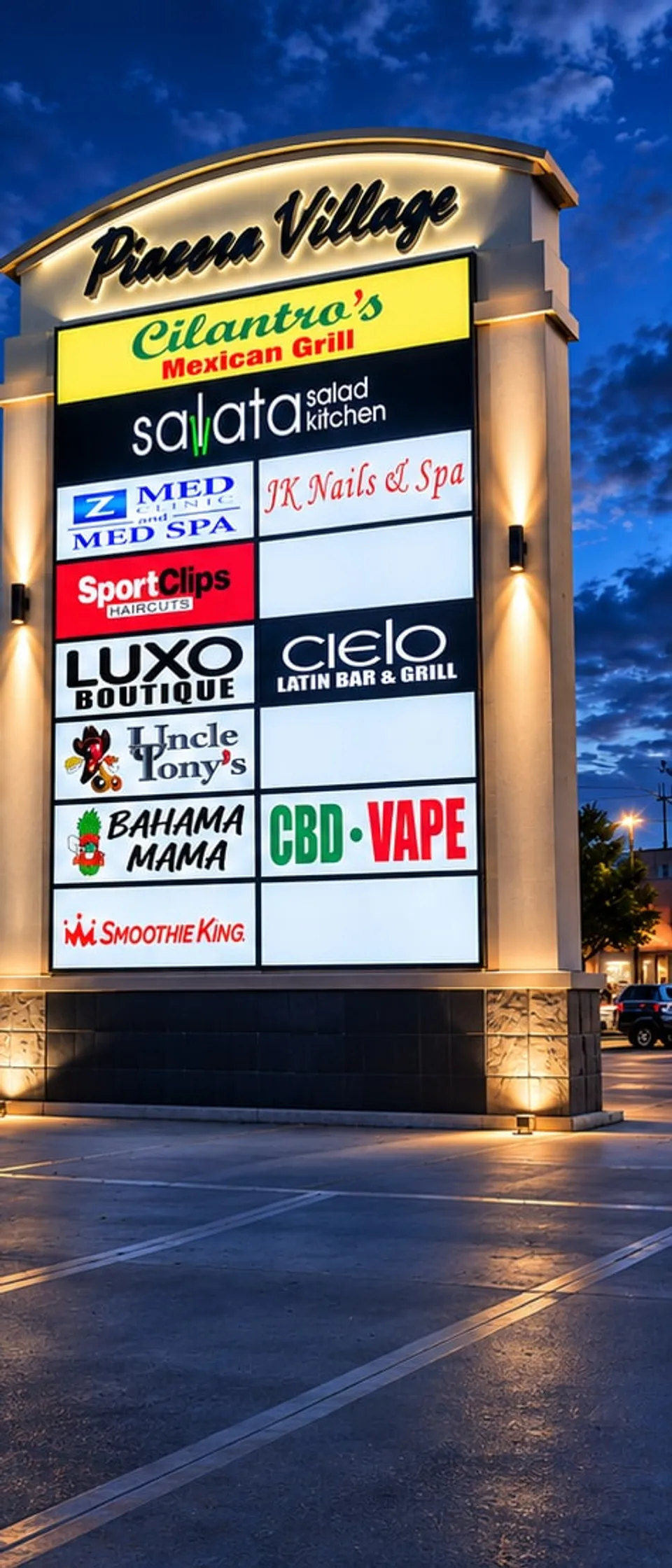
What tenant panels are
On a multi-tenant pylon or monument sign, each business occupies a panel: a removable face that slides into a track or sits behind retainers in the lit cabinet. When a tenant leaves, the panel comes out; when a new one signs a lease, a new panel goes in. The cabinet, the illumination and the structure stay.
That sounds simple, and when the sign was built well it is. When it was not, panels are the wrong size for the opening, retainers are bent, the cabinet has dark sections, and a “simple” panel swap turns into a repair. We handle both the simple version and the other one.
Panel construction options
Flat printed panels. White polycarbonate or acrylic with translucent vinyl or direct print graphics. The most economical option, quick to produce, and fine for most retail centers. Polycarbonate stands up better to hail and to the flex of a tall pylon.
Routed aluminum with push-through acrylic. An opaque aluminum panel with the letters and logo cut out and acrylic letters pushed through so only the copy lights at night. It reads sharper, looks more upscale, and is what many newer centers and medical office parks require in their criteria.
Routed with backed-up acrylic. The cut-out letters are backed with acrylic flush to the panel rather than pushed through. A middle option in cost and look.
Day/night panels. Printed so the background reads one color by day and another at night, used where a criteria calls for a specific daytime look with a lit white background at night.
Every panel is built to the measured opening and the retainer style on that cabinet, not to a catalog size, which is why we survey rather than quote from a photo.
Working from the landlord’s sign criteria
Most retail and office properties have a sign criteria package that governs tenant signs: panel size, background color, letter height limits, whether logos are allowed, and illumination rules. We read it before we draw anything, produce the panel drawing to it, and submit it to the landlord for approval with the tenant copied. That approval is what lets the panel go up on schedule; skipping it is the most common reason a panel gets rejected after it is made.
If a property does not have a criteria package, we can write one for the owner so every future tenant sign matches and future panel swaps are one-trip jobs.
Tenant turnover for property managers
A property manager’s version of this job is different from a tenant’s. You have a vacant panel that reads as a vacant space to every driver on the road, a new lease with a sign exhibit, and a sign company the tenant chose who may or may not know the property. We make it simple:
- We keep a file per property with the cabinet measurements, retainer type, panel specification and photos.
- We produce a blank or “Now Leasing” panel for vacant positions so the sign never advertises a vacancy.
- We handle the tenant’s panel directly, to your criteria, with your approval on the drawing.
- We flag cabinet problems, dark sections or structural issues while we are up there, so you hear about them from us before you hear about them from a tenant.
Full re-faces: refreshing a whole sign
A pylon or monument that is structurally sound but looks dated, with faded panels, mismatched fonts and half its illumination out, is a candidate for a full re-face. Every panel and the property-name face are replaced at once, the illumination is retrofitted to LED, and the retainers and tracks are repaired or replaced. The structure and foundation stay, so there is no new engineering in most cases and often no new permit review.
For a center with a leasing problem, this is usually the highest-return sign work available: the shared sign is the property’s storefront from the road, and a bright, consistent pylon changes how the center reads to both customers and prospective tenants. Our LED retrofit service is folded into the same visit.
What affects the cost
Single panel replacements and full re-faces typically fall in the ranges shown below, installed. For a single panel the drivers are size, flat printed versus routed with push-through, and whether the height needs a bucket truck or a crane. For a re-face it is the number and size of positions, whether the illumination is retrofitted, and any repairs the cabinet needs once the old faces are off.
Permits
Replacing a panel with the same size and type is generally not a permitted activity in Houston-area jurisdictions. Changing the cabinet, the sign’s area, or the structure is. A full re-face that keeps the cabinet dimensions usually does not need a permit, but rules differ by city, and we check rather than assume. Our Houston sign permit guide covers what triggers a review.
Timelines
From an approved drawing, flat printed panels are typically fabricated within one to two weeks and installed in one visit. Routed aluminum panels run longer. A full re-face of a multi-tenant pylon is usually planned over several weeks and installed in one or two days, scheduled around the property’s traffic.