
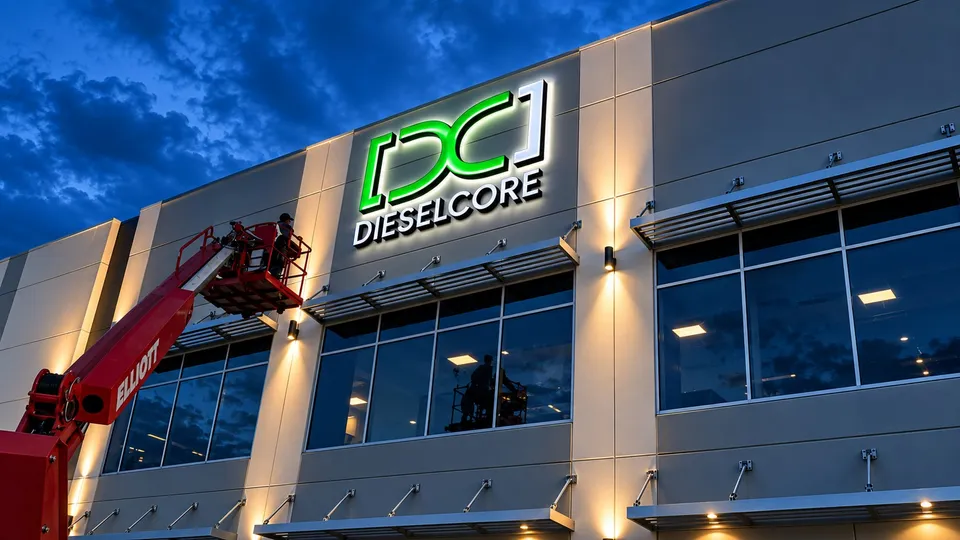
A dark sign costs more than the repair
Customers notice a half-lit sign before they notice anything else about a business, and property managers hear about it from tenants. Most sign failures are small, cheap components: a power supply, a run of LED modules, a wiring connection that took on water. The expensive part is the trip and the lift, so our goal on every service call is to diagnose and fix on the first visit.
What we repair
- Channel letters: dark or partially lit letters, flickering, faces cracked by heat or hail, trim cap separating, water inside the letter.
- Cabinet signs: dark sections, failed ballasts or power supplies, cracked or faded faces, damaged retainers.
- Pylon and monument signs: dark cabinets, damaged tenant panels, doors and retainers that will not close, base-plate corrosion.
- Neon: broken tubes, failed transformers, GFI trips, and full conversion to LED.
- Storm damage: faces blown out, cabinets shifted, letters knocked loose. We make the sign safe first and quote the rebuild after.
- Electrical: timers and photocells, disconnects, damaged conduit, and connections that trip the breaker.
How a service call goes
- You tell us what you see. A photo from the parking lot at night is the most useful thing you can send.
- We come out with the bucket truck and open the sign. We test power supplies and module runs individually, check for water, and look at the wiring and connections.
- We fix it on the spot when we can. The truck carries the common power supplies, modules and connectors. If the sign needs a part we do not stock, or a new face, we secure it and come back with the part.
- You get photos of what failed and what was replaced.
A typical service call, including the lift, diagnosis and the common replacement parts, falls in the range shown below. Anything structural, or storm damage, is quoted after we see it.
LED retrofit: what it is and when it pays
A retrofit replaces the light source inside an existing sign, usually neon tubes and transformers or fluorescent lamps and ballasts, with LED modules and low-voltage power supplies. The sign’s faces, letters and structure stay. The result is a sign that draws a fraction of the power, runs cool, has no glass to break and no high-voltage transformer to fail, and needs service far less often.
It pays fastest on signs that are lit many hours a day and on older neon signs where every service call means glass tube work. It also solves the “one section dark every few months” cycle that fluorescent cabinets fall into as lamps and ballasts age at different rates.
A proper retrofit is not just swapping parts. The LED modules are laid out for even illumination across the face, which is a different pattern from where the old lamps were, and the power supplies are sized for the load and mounted where they can be reached for future service. A cheap retrofit shows hot and dark spots on the face at night; a good one looks like a new sign.
Timers, photocells and signs that never turn on
A surprising share of “dark sign” calls are not the sign at all. A photocell that has failed or is pointed at a security light, a timer that lost its schedule after a power outage, or a tripped GFI in the disconnect will keep a perfectly good sign off every night. We check the control side first because it is the cheapest fix there is, and we set timers and photocells so the sign comes on at dusk and off when the store closes, which also trims the power bill.
When a repair becomes a replacement
We tell you when repair is not the right call. A cabinet with rust through the skin, faces so faded the brand colors are gone, a pylon with a corroded base plate, or channel letters from a brand you no longer use are usually candidates for a new sign or a re-face rather than another repair. We quote both options and explain the difference.
Permits for repairs
Like-for-like repairs, replacing a power supply or a face with the same thing, typically do not require a permit. Changing the sign’s size, structure or copy, or rebuilding a storm-damaged structure, usually does. An LED retrofit that changes the electrical load may need an electrical permit in the City of Houston. We tell you which applies before we start. Our permit guide has the fees.
For property managers
Multi-tenant properties have the most signs and the least time to chase them. We offer scheduled night surveys of a property’s signage, batched repairs so one truck trip covers several tenants, and a file for each sign with photos and the parts it uses. When a tenant calls you about a dark sign, forward it to us and we handle the rest.
Timelines
Diagnosis and simple repairs are usually one visit. Parts we do not stock add a few days. Retrofits are typically a day per sign, depending on size, and can be scheduled at night for retail. Face replacements depend on the shop schedule and any printing lead time.