
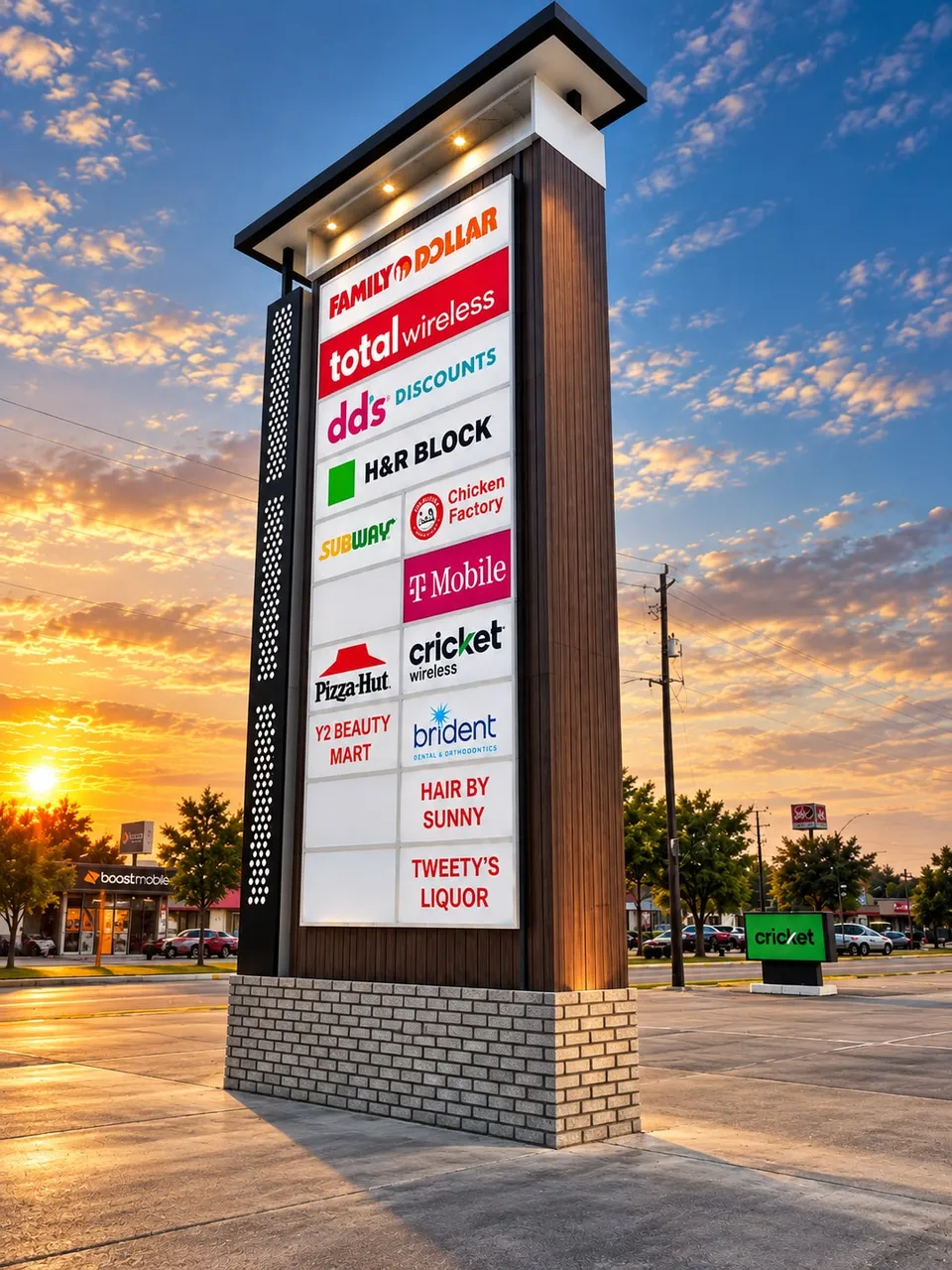
What a pylon sign does that nothing else can
A pylon sign is a tall freestanding sign on one or more steel poles, built to be read from a distance: from a freeway feeder road, across a large parking field, or from the far side of a six-lane arterial. It is the sign that tells a driver a retail center, a dealership, a restaurant or a gas station is coming up in time to change lanes.
For multi-tenant retail, the pylon is also the property’s shared advertising. Every tenant panel on it is a lease amenity, and a property manager with a well-built, well-lit pylon has an easier time filling space than one with a dark or leaning sign.
Anatomy of a pylon sign
- Foundation. A drilled concrete pier, engineered for the soil and the wind load, with anchor bolts set to a template. In Houston clay this is deep, and it is the part of the sign nobody sees and everybody depends on.
- Pole or poles. Steel pipe or tube, sized by the engineer, with a base plate that bolts to the foundation. Single-pole for smaller signs, twin poles for wide cabinets.
- Pole cover. Optional aluminum or masonry cladding that hides the steel and matches the building. This is what turns a pole sign into a pylon.
- Cabinets. Aluminum frames and skins, internally lit with LEDs. The top cabinet usually carries the center or business name; the tenant cabinet below carries individual panels in tracks.
- Faces and panels. Flat polycarbonate or acrylic with translucent graphics, or routed aluminum with push-through acrylic letters for a sharper look.
- Electrical. A dedicated circuit to the sign, a disconnect at the pole, and the low-voltage power supplies inside the cabinets.
Single-tenant versus multi-tenant
A single-tenant pylon, for a dealership, a restaurant or a freestanding retailer, is usually one large cabinet or a set of channel letters on a cabinet, designed around one brand. It can also carry a changeable message board or an electronic message center where the code allows.
A multi-tenant pylon carries the property name on top and a stack of tenant panels below. The design questions are practical: how many panels, what size each one is, whether anchor tenants get larger positions, and how a panel gets swapped when a tenant leaves. We build the tracks so a panel replacement is a one-trip job with a lift, and we keep the panel specification on file so the property manager can hand it to the next tenant.
Height, area and the code
Pylon signs are the sign type most likely to run into code limits. Height and area allowances in the City of Houston depend on the street classification and the lot’s frontage, and each surrounding city has its own table. A design that assumes a height the property is not entitled to means a variance, a hearing and weeks of delay.
We check the limits for the specific address before the design is drawn, and we tell you up front if the sign you have in mind would need a variance. Our Houston sign permit guide explains what triggers one and what it costs to pursue.
Foundations, wind and Houston soil
Two forces work on a pylon: the wind pushing on the cabinets like a sail, and the clay under the foundation swelling and shrinking with the seasons. The engineer designs for both, and the result is a pier deeper and wider than people expect. That is not padding. A pylon that leans after a few years almost always has a foundation that was sized for a different soil or a different wind speed.
Gulf Coast design wind speeds are among the highest in the country, and the calculations for a Houston pylon are not interchangeable with a sign built for Dallas or Austin. Every pylon we set has a sealed drawing specific to the site.
Installation day
The foundation is drilled and poured first and cures for the period the engineer specifies. On crane day the pole is stood on the anchor bolts and plumbed, the cabinets are lifted and bolted on, and the electrical is connected. For a retail center this typically closes a few parking spaces for part of a day; we schedule early mornings or off-peak hours and coordinate with the property manager. Overhead power lines near the frontage are checked at the survey because they affect both the sign’s location and the crane’s setup.
What affects the cost
Installed pylon signs in the Houston area typically fall in the range shown below, and the spread is wide because the sign types are. The drivers are overall height and cabinet area, single versus multi-tenant, whether the design needs freeway-scale illumination, the foundation the soil and wind require, the electrical run from the building, and the pole cover material. A modest single-pole tenant sign on existing power sits at the low end; a tall twin-pole multi-tenant pylon with a masonry pole cover and a long trenched electrical run sits at the top.
Re-facing versus replacing
If your existing pylon’s pole and foundation are sound, a full re-face with new cabinets, panels and LED illumination costs a fraction of a new sign and avoids a new foundation and, often, a new permit review. We inspect the structure first. If the steel is corroded at the base plate or the foundation has moved, we tell you, because a new cabinet on a failing pole is money wasted.
Who we build pylons for
Property managers and owners of retail centers, auto dealerships that need sales and service visible from the road, restaurants and QSR operators on pad sites, gas and convenience operators, and general contractors delivering new centers with the pylon in the scope. Send the address and the tenant list and we will draw the sign to what the code allows at that frontage.